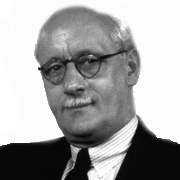
Jean Nussbaum was a Swiss-French physician born on 24 November 1888 in La Chaux-de-Fonds, Switzerland.
At the outbreak of the First World War in 1914, he was practising medicine in Chamonix, France. At the time, Serbia was suffering from a severe typhus epidemic and urgently needed international medical help. Nussbaum volunteered to help and was sent to a hospital in Niš, Serbia.
Upon his arrival, Nussbaum was paired with a young Serbian nurse, Milanka Zaritch, who also acted as his interpreter. She and Nussbaum developed a deep bond and eventually married in the autumn of 1915.
Milanka Zaritch was the niece of Voyislav Marinkovic, a notable Serbian and Yugoslav diplomat who later became Prime Minister of Serbia. This family connection would open doors in the future for Dr. Jean Nussbaum, introducing him to diplomatic and international circles.
Returning to his stay in the hospital, Jean Nussbaum encountered the situation of an Austrian prisoner of war who had been sent to serve in the hospital and who wanted to practice the principles of his faith. The prisoner had put himself in grave danger by refusing to obey orders. Nussbaum intervened to save his life. This incident was a turning point for Nussbaum, triggering his lifelong commitment to the promotion and defence of freedom of conscience and religion.
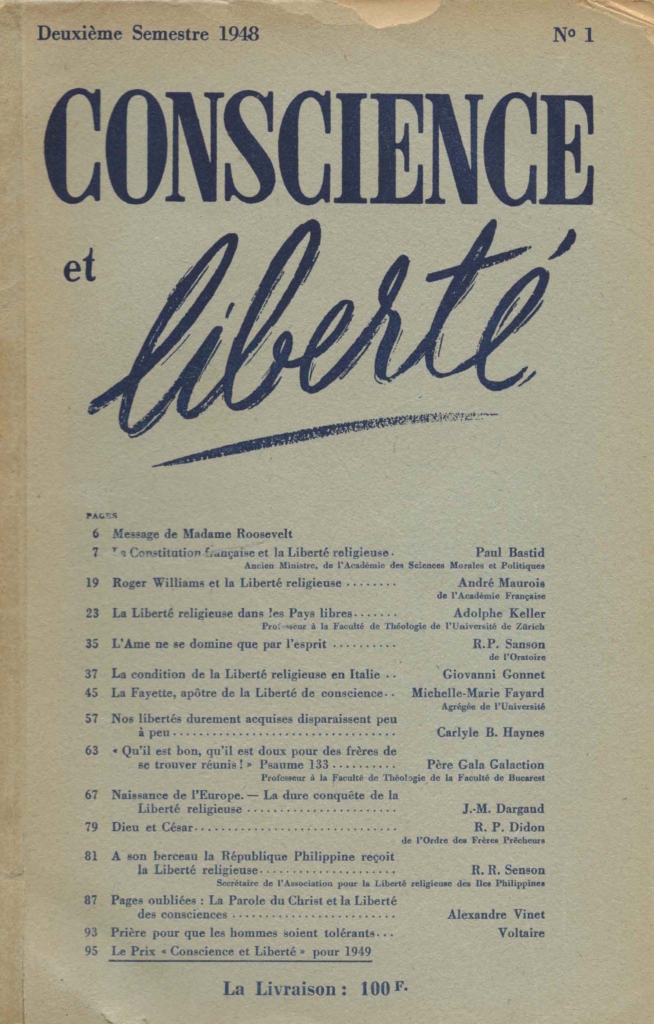
Fifteen years later, in 1931, he returned to Switzerland and then to France, where he settled with his wife in Paris, working as a doctor. It was there, in 1946, that he founded the first branch of the Association internationale pour la défense de la liberté religieuse (AIDLR).
The couple had only been living in Paris for a few months when Dr Jean Nussbaum was invited by religious circles to participate in a debate on a project to reform the world calendar[i]. This project was to be presented in October 1931, during the plenary session of the fourth International Convention on Transport and Communications held in Geneva by the League of Nations. The Preparatory Commission for this Convention stated in its preliminary report that the delegates at this meeting had not presented any arguments suggesting that the proposed reform might be incompatible with religious practices. As a result, representatives of religious groups were invited to present their views. While the representatives of the nations considered the issue from an economic and social point of view, most religious observers had, however, realised that it affected millions of believers around the world, in particular Jews, Christians and Muslims.
In a report on this Convention, dated 14 October 1931, Joseph Herman Hertz, Chief Rabbi of the Jewish community of the British Empire, recounted the intervention of Dr. Jean Nussbaum as follows:
‘Dr. Nussbaum urged the representatives to remember that this was an important question of conscience, and that any interference with human conscience was incompatible with the ideals of the League of Nations. All previous interventions by observers had been made in English, and several delegates had only been able to follow them through translation. This masterful speech in French, however, touched their hearts´.
Two years later, Dr. Jean Nussbaum was elected by the full delegate body of the Southern European Division of the Seventh-day Adventist Church as director of its Religious Liberty Department. While practicing as a medical doctor, he began to work for religious freedom, and in this work, he received the support of several international personalities. The most significant of these was undoubtedly Pope Pius XII, with whom he had maintained a friendly relationship when he was still Cardinal Pacelli. Dr. Nussbaum also spent part of his time working for the Washington-based International Religious Liberty Association (IRLA).
After World War I, the political restructuring of Central Europe, from the Danube to the Balkans, with its economic, social and religious implications, produced many difficulties for Christians in various nations in this part of the world.
In his personal notes on his activities, Jean Nussbaum gave an account of his visits to political and religious figures in Bulgaria, Hungary, Poland, Romania and Yugoslavia, but he also travelled extensively in Spain, Ethiopia, France, Great Britain, Greece and Italy. He took a keen interest in the situation in Japan and intervened on behalf of Protestant, Catholic and Orthodox Christians in difficulty.
In Oxford in July 1937, Nussbaum met Marc Boegner, a Protestant theologian and member of the French Academy, then president of the French Protestant Federation. Their friendship continued until Dr. Nussbaum’s death in 1967. These two men shared a deep appreciation for each other and, although their views on how to protect religious freedom differed, they worked together for their common principles.